Tracey Emin, Artist, London
Jerry Gorovoy, Louise Bourgeois’s longtime assistant, New York
Nancy Spector, Deputy Director and Chief Curator, Solomon R. Guggenheim Museum, New York
Moderator | Ulf Küster, Curator, Fondation Beyeler, Riehen/Basel
Art Salon series: Remembering Louis Bourgeois
by Artcards Review on December 5th, 2011
Other Spaces Generates New Spaces Through Sound at LEAP
by Kristin Trethewey on December 3rd, 2011
Last Saturday LEAP, the Lab for Electronic Arts and Performance, launched a new bi-monthly series called Body Controlled, presenting
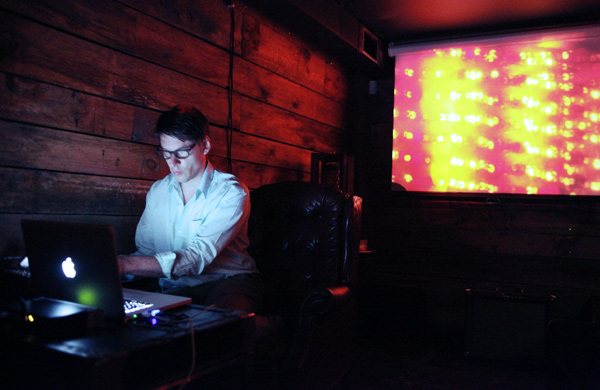
artists dedicated to performance art and exploring sound using electronics and other art forms. For its first installment titled, Other Spaces, the artists used the dynamic of preexisting architecture and virtual spaces as a point of departure for work on display through December 2, 2011. Highlights of Saturday’s inaugural event included Robert Henke’s twelve-hour installation/performance, Microsphere. Well known within both academics and club culture Henke has been involved in negotiating the evolution of computer based music for decades and helped pioneer today’s standard software for live performance, Ableton Live. While I only stayed for the first two hours of his set visitors were welcome to pass by until mid-morning the next day, breakfast was apparently served in the final hours. During the time I was present I took notice of Henke’s peaceful performance demeanor, the invisible anxiety that permeates most was non-existent. His expert execution allowed sounds to develop within the space breaking down typical audience-performer barriers. Focus returned to the audience and the space as Henke took short smoking breaks and even ate some grapes while he played at what looked like a recording station from the future. Massive cabling protruded from the back of a desk that was under lit by a florescent red tube and a carefully rigged computer screen floated, suspended from the ceiling. Fluctuating between listening to the development of sound, Henke added various traditional and non-traditional instruments to the mix and their play back became part of a developing new sound and spatial atmosphere.
Scopophilia @ Matthew Marks Gallery
by Gabriella Radujko on December 3rd, 2011
Single-handedly, Scopophilia, the 25-minute slideshow and centerpiece Nan Goldin’s show at the Matthew Marks Gallery show generates empathy for Goldin’s subjects, those demi-monde friends appearing in alternating states of intimacy and quiet dysfunction. For about half an hour, the transgressive vulgarisms associated with her work are forgotten. Instead, viewers experience a pastiche accompanied by a liberating soundtrack and the juxtaposition of images typical of her aesthetic with ethereal masterpieces depicting eternal devotion, love and tenderness.
Mckeever Donovan at Important Projects
by Craig Smith-Dermody on December 2nd, 2011
Once when I was a kid, I decided to rub two magnets along the surface of my mother’s computer. The technological myth proved true and her hard drive was wiped completely. In similar form, McKeever Donovan’s New Work explores the affective capacities of seemingly empty decorative archetypes. Donovan utilizes this space to provide the simultaneous conception and exploration of a blank slate from which his compositions emerge.
The on-paper layout of the show is as modest as the aesthetic of its comprising works. Small magnets float on the surface of three framed monochromes. A sculpture comprised of metal tubing rests on the floor atop two bath mats. The color options are equally basic. Khaki, indigo, grey, primary blue and red; a dominant presence of utilitarian décor reinforces an investment in aesthetic accountability. Donovan’s this-and-not-that approach to material selection provides a grounds for divorce from the immediate ready-made coding of the hardware store vocabulary, enabling closer engagement with the virtual-rendering capacities of its signified(s). Monochromes and bath mats serve as ground for the material gestures of magnets and tubing. These gestures mark identity and form within their respective decorative grounds, wresting affective impact from formal composition.
Fran Herndon at Altman Siegel Gallery
by Aaron Harbour on October 27th, 2011

- Fran Herndon, Opening Day, 1961
Catch Me If You Can: A cluster of greyhounds surging into the foreground, muzzled, wearing numbers, chasing a hastily rendered pair of rabbits through roughly sketched grass. On a muted grocery bag or faded newspaper backdrop are other creatures and, in the center, obscured by washes of pale blue, an indistinct crowd. Powerfully narrative, but hazed by the manner of its construction, this image is fugitive. The characters resist any simple one-to-one relation with the viewer who’s personage spreads out piecemeal across the image. There is a spectacle here, echoed in the other collages on display.
Black Mountain College and Its Legacy @ Loretta Howard Gallery
by Gabriella Radujko on October 24th, 2011
At the heart of the interdisciplinary, experimental approach to art making documented in “Black Mountain College and Its Legacy” at the Loretta Howard Gallery, is a human ethology that emphasizes cooperation and interdependence. What happened at Black Mountain College is as nostalgic as it is antithetical to western society’s preoccupation with the importance of the individual over the group, most recently highlighted with the passing of Apple’s visionary icon earlier this month.
Featured Artist: Oliver Warden
by Amanda Schmitt on October 24th, 2011
A young woman rounds the corner and catches a glimpse of her reflection in a full-length mirrored box. Attracted to this, she stops to make sure her bangs are okay, and notices that the mirror also has a switch, at perfect doorbell height. Curious, she flips the switch, only to immediately jump back, letting out a half scream, half laugh. She might be going crazy, she thinks, but she swears she just saw her reflection change into that of a man’s. Intrigued, she presses the switch a second time, and registers the flashing image of him again. Sure enough, inside the two-way mirror is a man, about 6’, standing at the ready, in a grey suit with a black tie. He has the appearance of James Bond, but the moxy of Elvis Presley vis-à-vis Andy Warhol’s prints. This man also has an identically placed switch on his side of the mirror. While the young woman can turn on the light, revealing the man, he has the power to turn the light off. The young woman giggles, fascinated by her power, yet she still feels the need to touch the switch again, and sees the opportunity to compete; a game ensues. She continuously turns on the light, as fast as she can, trying to reveal the man, to find out who he is, and what he looks like. He is calm and quick to the switch; she is relentless. She giggles more and more, and he remains stone cold 007, intensely staring into her eyes. You can see he is sweating, somewhat annoyed yet maintaining his authority, which fuels this woman’s sadistic tendencies even more. Who will win?


RSS